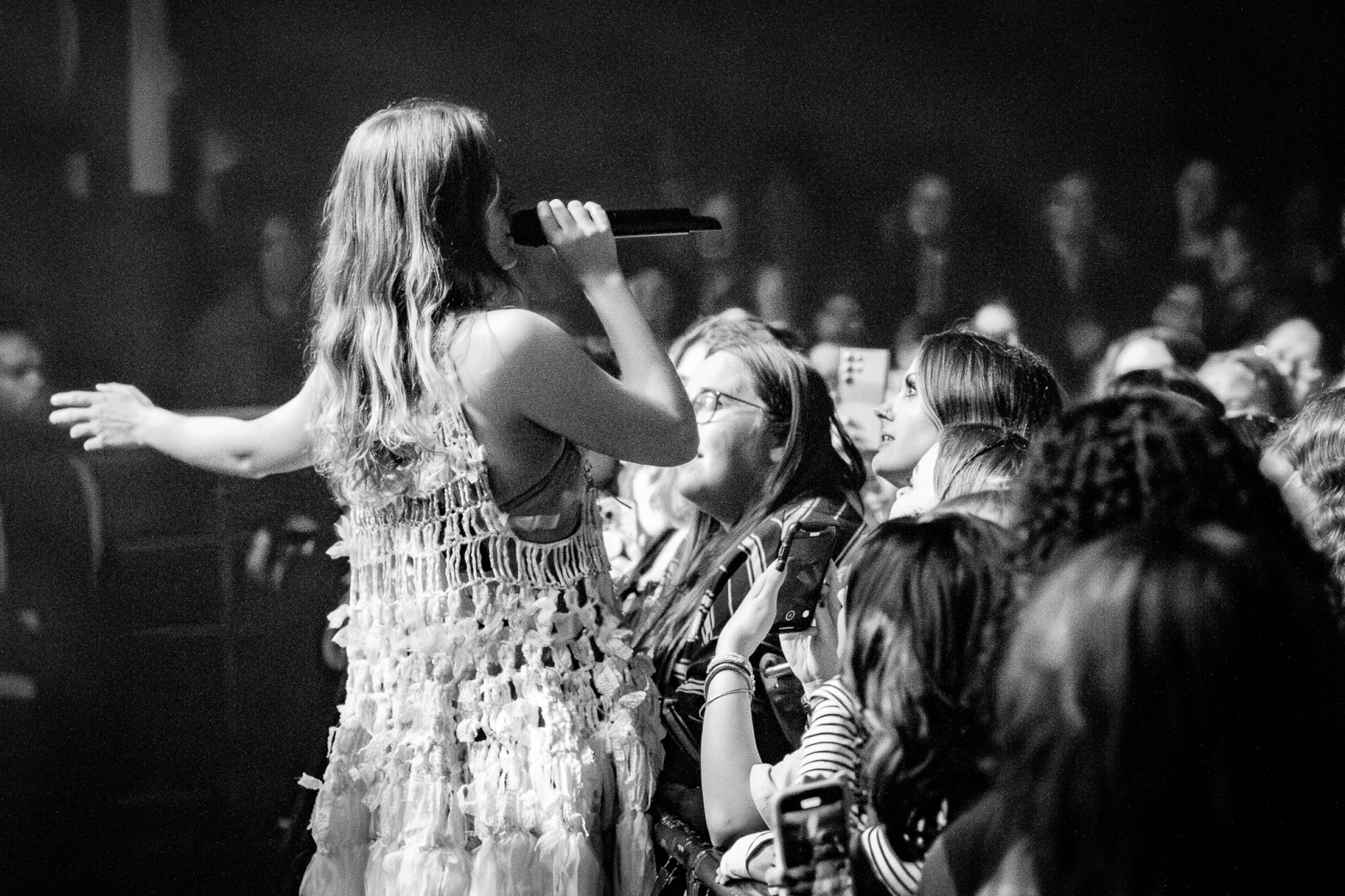
SWX, Bristol, 2nd December 2024
Even an hour after doors, there is still a large queue outside SWX. I walk past the hundreds of people circling the building, hoping to make it inside in time for Luvcat. For the first time, Luvcat is not accompanied by the rest of her band, yet this loneliness is barely noticeable in her peaceful, soft, yet commanding stage presence. With songs about femicide and dumping your first boyfriend on Christmas Eve, Luvcat has created an empowering yet mysterious and looming sound that one day could be the hauntingly beautiful soundtrack of a Bond film or, even better – an action drama with a female lead.
In between sets, the merch area is busier than ever, with the line wrapping all around the room. Upon having a look, I see the infamous bookcase. Throughout the tour, Paloma has encouraged fans to participate in the free book exchange. A free library filled with feminist literature and more, it is one of the things that sets them apart as an artist. It is not just about the music but about the community. The tour guide encourages everyone to wear fairy-inspired clothing, red ribbons inspired by ‘drywall’, or whatever fans feel comfortable and magical in. Alongside the book swap, people are encouraged to exchange ‘fairy messages’ with others, including favourite song lyrics, what brings people to the show, poems, and book quotes.
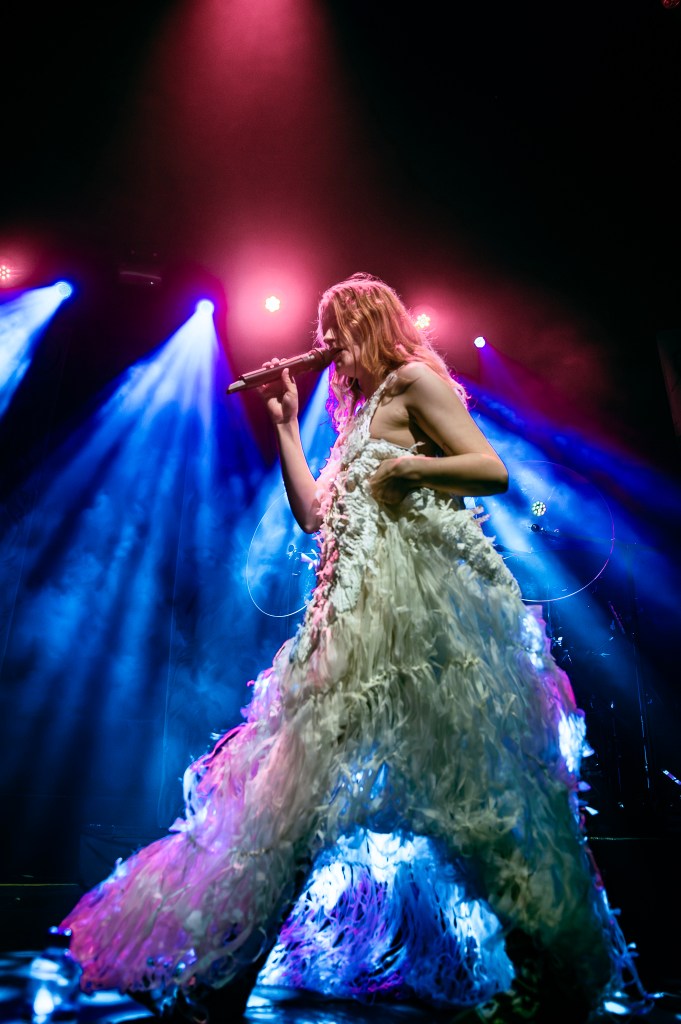
Paris Paloma starts their set with ‘my mind (now)’, the opening track of their latest record, Cacophony, with just her (nearly incomprehensible) raw acapella vocals and some soft distant instrumentals. The beat drops after the line “… to endure what you put me through, I don’t think you would pull out on the other side”, and the room is immersed with their powerful vocals, colour, synths, the rhythm of the drums and some dramatic brass. Whilst not all of these sounds seem to be performed live, the 1 hour and 15-minute set starts in the most cacophonous way possible, defining the album and tour title in just the first song of the night. Knowing that most of the setlist is expected to be much quieter, I know who I am here to see and that Paloma’s angelic vocals are the highlight of the performance.
Followed by ‘drywall’ and ‘as good a reason’, the room fills with the warmth of Paloma’s presence. The nurturing, empowering energy Paloma and their fans bring, where wearing flower crowns or big white flowy dresses does not define who you are, but a safe space to express your deepest, most authentic self. “There’s an old man somewhere, seething,” sings the crowd along with Paloma, “and spite’s as good a reason to take his power”, proving that no one can take this moment of self-expression away from them – including the pedalboard that Paloma’s dress gets stuck on, which is immediately laughed off, adding to the authenticity and genuine expression of this performance.

Whilst many of Paloma’s songs fuel the fire of this ancestral, feminine rage, it is not a women-only event. It is an incredibly welcoming and inclusive space, where everyone who resonates with the songs is part of the community – a community in which its members are frequently referred to as ‘fairies’. The fairy theme is more than just community; it is something magical, and everyone can sense that as the show continues, as the space is immersed with Paloma’s sonic magic. ‘the warmth’ almost sounds like a spell being cast, and I can feel its protection pulsate through my bloodstream; “It can’t hurt me, it’s still there but it can’t now the warmth’s returning.”
This feeling of protection only grows stronger throughout the set. Paloma tells us that she loved The Hobbit growing up and that Ed Sheeran’s ‘I See Fire’ is a huge musical inspiration to her, which is also why they bought their first guitar. You don’t have to be a Lord of the Rings fan to understand the honour of writing a song for its soundtrack, an honour Paloma fulfilled so splendidly with ‘The Rider’. She performs the track in full, and I immediately feel transported to this dark, windy, cold land far from here, trying to imagine what the Lord of The Rings universe looks like as someone who’s never seen it, but I know I would be safe under the spell of Paris Paloma’s sound.
Nearing the end of the set, we know the viral TikTok hit from 2022 is coming, and so the crowd is waiting in anticipation. Paloma expresses gratitude to the audience for their patience with her illness and for showing up to the rescheduled date. They also mention that they normally perform barefoot but had to slip on a pair of cheap socks due to the cold.
The first sounds of ‘labour’ echo through the room. Folk music has always been known for its origin in its authentic expression of ways of life – whether that is a way of life that has passed, is passing, or to be preserved or revived. The genre has historically been used to orally pass down community-oriented stories, characterizing one side of a cultural dichotomy, often speaking about historic and personal events, tragedies, and oppression – ‘labour’, discussing the ongoing effects of the patriarchy and its associated gender roles, the abuse that comes with it, and its gender inequality, is a song many people in the audience can relate to, which makes its ongoing online viral trajectory all the less surprising.

Right before the viral bridge, Paloma asks the crowd to sing along with her as loudly as they can if they know the words: “All day, every day, therapist, mother, maid. Nymph then a virgin, nurse then a servant. Just an appendage, live to attend him so that he never lifts a finger” – and Bristol shows up as expected, and the room is instantly saturated with the powerful voices of the audience “24/7 baby machine, so he can live out his picket fence dreams. It’s not an act of love if you make her, you make me do too much labour.”
Paris Paloma is the epitome of modern folk music, using her spellbinding vocals to create a community of people from different backgrounds that all connect through the day-to-day issues discussed in many of Paloma’s songs. Folk music is, and always has been, music by and for the people, a communication tool, and a way to connect with the community – Paloma has succeeded in doing exactly that, whether through the poetic and ancestral nature of her music, the ‘fairy messaging’, or the free library, it has brought people together. When many people continue to frolic, dance, sing, and connect with each other even after Paloma and her band have left the stage, I know I can say with absolute certainty that if the love for Paris Paloma dies, it would be “a bad thing.”
Words and photos: Willemijn Denneman, no use without permission.

 TrueStyleMusic